

News
&
Updates

Testimony: NYS Assembly Committee on Housing Hearing on Affordable Housing
In 2016, LiveOn NY conducted a survey, entitled “Through the Roof” which found that an estimated 200,000 seniors are on wait lists for housing through the HUD202 program in New York City. The lack of affordable housing can have adverse effects on a senior’s health as it forces one to make the difficult choice between skipping meals, going without medications, or avoiding needed healthcare in order to afford rent.
New York State Assembly
Assembly Standing Committee on Housing
December 14, 2017
Oversight of the State Fiscal Year 2017-2018 State Budget for New York State Homes & Community Renewal
Thank you to Chairperson Assemblyman Cymbrowitz and to the Assembly Committee on Housing for the opportunity to testify today.

LiveOn NY would like to first and foremost thank Governor Cuomo and the entire legislature for the investment made last fiscal year of new affordable housing capital funding. More specifically, we thank the state for the creation of the first capital funding stream for affordable senior housing, allocating $125 million over the next 5 years.
This investment in new affordable senior housing is critical due to the dire need throughout the state. In 2016, LiveOn NY conducted a survey, entitled “Through the Roof” which found that an estimated 200,000 seniors are on wait lists for housing through the HUD202 program in New York City. The lack of affordable housing can have adverse effects on a senior’s health as it forces one to make the difficult choice between skipping meals, going without medications, or avoiding needed healthcare in order to afford rent.
LiveOn NY is hopeful that the critical investments made last fiscal year will help to combat the current housing crisis for seniors and New Yorkers of all ages. Beyond these capital investments, LiveOn NY urges investments to be made in the upcoming fiscal year to fully support seniors by providing service coordinators in both newly constructed and existing senior residences.
Service coordinators in senior housing residences are proven to reduce health care costs. In fact, LiveOn NY’s member Selfhelp Community Services just released a study of the residents in Selfhelp’s senior affordable housing program. They study compared Medicaid data for residents in their housing in two zip codes and compared it to other seniors living in the same zip codes over two years.
The crucial research found that the seniors living in Selfhelp’s affordable housing had much more positive outcomes including:
68% lower odds of being hospitalized
$1,778 average Medicaid payment per person, per hospitalization for Selfhelp residents, versus $5,715 for the comparison group
53% lower odds of visiting an emergency room compared to a non-Selfhelp resident

In addition, a 2016 study of residents in affordable housing in Oregon showed that Medicaid costs declined by 16% just one year after seniors moved into affordable housing communities. Results also showed that primary care visits increased by 20%, while emergency room visits decreased by 18% and that properties with on-site health services produced the largest decrease in emergency room visits. A 2014 evaluation of the SASH program in Vermont revealed that growth in the annual total Medicare expenditures of program participants was lower by an estimated $1,756-$2,197 per person when compared to the growth of total Medicare expenditures in comparison groups.
In order to truly make New York the first Age Friendly state in the nation, investments in these proven cost-effective service coordinators must be made. LiveOn NY urges a new dedicated funding stream for services in existing and new affordable senior housing buildings. These services can help residents in remaining healthy and independent, supporting the overwhelming desire for seniors to age in place in their homes. This new program would be a strong pillar of the Governor Cuomo’s Health Across All Policies Initiative.
LiveOn NY thanks Assemblyman Cymbrowitz and the Standing Committee on Housing for holding today’s hearing and we look forward to working together in the upcoming fiscal year.
LiveOn NY’s members provide community-based services that allow older adults to thrive in their communities. With a base of more than 100 organizations serving at least 300,000 older New Yorkers annually, our members provide services ranging from senior centers, congregate and home‐delivered meals, affordable senior housing with services, elder abuse prevention services, caregiver supports, transportation, NORCs and NY Connects. LiveOn NY members also develop, operate, and provide services for affordable senior housing building throughout New York City. LiveOn NY advocates for increased funding for these vital services to improve both the solvency of the system and the overall capacity of community-based service providers.
LiveOn NY also administers a citywide outreach program that targets seniors in communities where benefits are most underutilized. This program helps to educate thousands of older adults, including those who are homebound, about food assistance options, as well as to screen and enroll those who are eligible for SNAP and SCRIE/DRIE.
LiveOn NY is also proud to administer the Senior Medicare Patrol (SMP) program for the entire state. A grant project funded by the U.S. Administration for Community Living (ACL), this program is aimed at preventing Medicare fraud. SMP is modeled around recruiting and actively engaging senior volunteers to promote peer counseling, education, and assistance. This provides seniors opportunities to not only educate themselves on Medicare issues, but also to get involved and give back to their community. SMPs educate Medicare beneficiaries on how to protect, detect, and report Medicare fraud, through this, SMPs are able to empower beneficiaries to reduce healthcare costs caused by errors, abuse, and fraud.

Testimony: State Assembly Aging Committee Hearing on Community-Based Services for Seniors
By 2040, the 60-plus-population will rise to an estimated 5.6 million individuals. These are 5.6 million individuals that should have the opportunity to be supported by a fully-funded network of community-based services in their community.
New York State Assembly
Assembly Standing Committee on Aging
December 6, 2017
Examination of Non-Medical Programs that Support Seniors in the Community
Thank you to Chairperson Assemblywoman Lupardo and to the entire Assembly Committee on Aging for the opportunity to highlight the cost-effective and exemplary work of the non-medical programs statewide that support a senior’s ability to age with dignity and grace in their communities. Further, we want to particularly recognize Chairwoman Lupdaro’s support and efforts last fiscal year to prevent the devastating Title XX cuts that would have closed 65 senior centers in NYC alone. We also recognize and thank Senator Sue Serino, Chair of the Senate Standing Committee on Aging for her leadership on these issues as well.
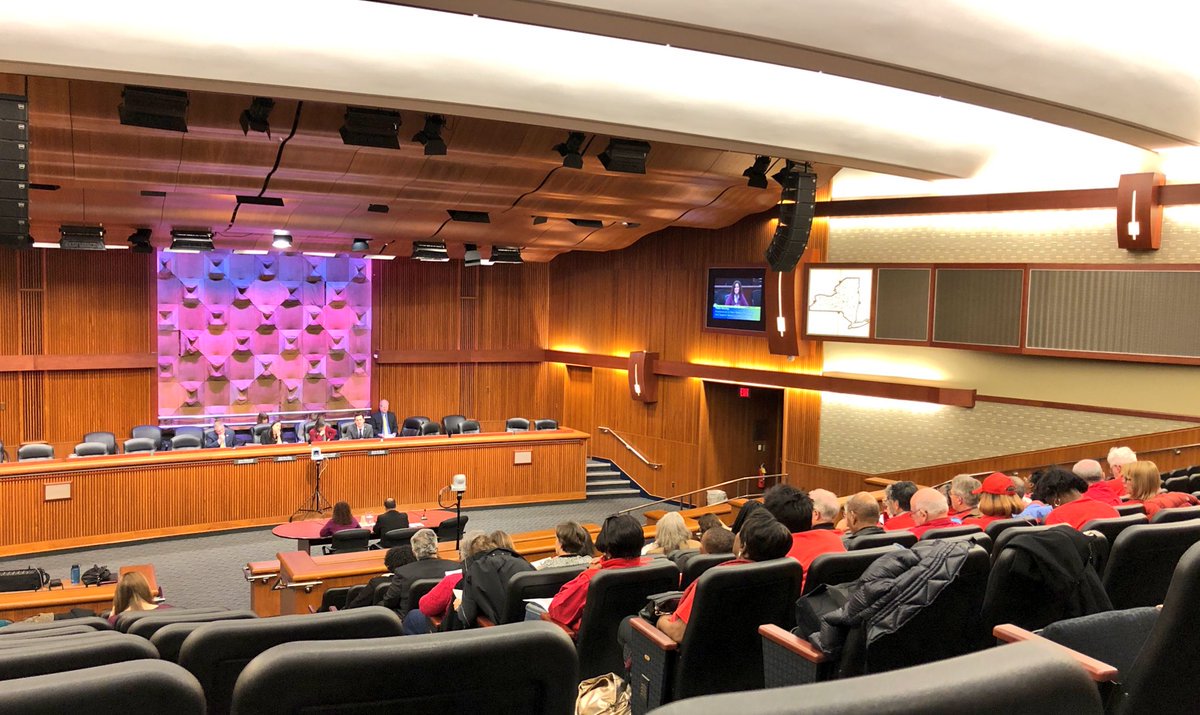
LiveOn NY’s members provide these core, non-medical services that allow older adults to thrive in their communities. With a base of more than 100 community-based organizations serving at least 300,000 older New Yorkers annually, our members provide services ranging from senior centers, congregate and home‐delivered meals, affordable senior housing with services, elder abuse prevention services, caregiver supports, transportation, NORCs and NY Connects. LiveOn NY members also provide the crucial Expanded In Home Services for the Elderly Programs (EISEP) which include case management and homecare. LiveOn NY advocates for increased funding for these vital services to improve both the solvency of the system and the overall capacity of community-based service providers.
LiveOn NY also administers a citywide outreach program that targets seniors in communities where benefits are most underutilized. This program helps to educate thousands of older adults, including those who are homebound, about food assistance options, as well as to screen and enroll those who are eligible for SNAP and SCRIE/DRIE.
LiveOn NY is also proud to administer the Senior Medicare Patrol (SMP) program for the entire state. A grant project funded by the U.S. Administration for Community Living (ACL), this program is aimed at preventing Medicare fraud. SMP is modeled around recruiting and actively engaging senior volunteers to promote peer counseling, education, and assistance. This provides seniors opportunities to not only educate themselves on Medicare issues, but also to get involved and give back to their community. SMPs educate Medicare beneficiaries on how to protect, detect, and report Medicare fraud, through this, SMPs are able to empower beneficiaries to reduce healthcare costs caused by errors, abuse, and fraud.
The topic of today’s hearing surrounds non-medical programs that support seniors in their community. We would like to open by acknowledging that while programs such as senior centers, NY Connects or home-delivered meals are non-medical by definition, their impact most certainly has a positive effect on the overall health of a senior and even a reduction in costs that would otherwise be imposed on the healthcare system. The work of these non-medical community based services can certainly have health impacts, from lowering rates of depression, to preventing isolation, to even reducing hospitalization rates for seniors. It is important to challenge our current framework used to think about community-based services to one that represents their reality: a network of programs in every community working together to holistically improve a senior’s quality of life and their overall health.
The work of the non-medical community-based service sector must be seen as a viable partner and compliment to the overall healthcare system in New York. Funding and policy is needed to enable community-based organizations to expand their data collection and analytics capacity in order to fully and appropriately integrate with the healthcare system. While the community-based service providers have decades of experience in improving outcomes for their senior participants, articulating this fact has been near impossible due to these funding and data limitations. It is our desire to work with the State Office for the Aging, the Department of Health, the legislature, Governor Cuomo, and all interested parties to find ways to come together to continue to improve the quality of life of seniors throughout the state.

Further, this network of community based services, from senior centers, to transportation services, to elder abuse prevention programs help enable seniors to tap into the unquestionable momentum that is accumulated in later life. After years of working to build families, careers, and communities, Older New Yorkers throughout the state use this momentum to even further power up the economy, the political system, and their communities. In the 2017-18 city and state budget cycles, seniors sent over 40,000 letters to elected leaders to advocate for increase funding for senior services, a shining example of this point.
Beyond the aforementioned health impacts, New York state benefits an estimated $32 billion annually from unpaid caregiving services alone. This $32-billion-dollar impact is thanks to the over 4 million family caregivers providing unpaid care, the estimated 125,000 grandparents raising grandchildren throughout New York, and the multitude of kinship caregivers supporting their loved ones. Beyond economic gains stemming from caregiving, seniors contribute an estimated 119 million hours of volunteerism in the state at an economic value of $3.35 billion.
This incredible economic impact is likely to grow as the number of caregivers and older adults is projected to increase dramatically in the coming years. By 2040, it is estimated that the 60-plus-population will rise to an estimated 5.6 million individuals. These are 5.6 million individuals that should have the opportunity to be supported by a fully-funded network of community-based services in their community.
Unfortunately, this cost-effective system is at risk of insolvency due to inadequate funding and outdated capital investments, which in-turn creates extreme difficulty in retaining quality staff. Seniors are falling through the cracks due to stagnation in the overall SOFA budget and at times, even dramatic cuts to these important programs. There’s a human impact of this unfair budget - growing waiting lists, staff burnout, and a lack of a safety net for seniors.
For the workforce associated with these community-based aging service providers, the need for increased funding could not be clearer. A 2017 report by the Human Services Council (HSC) found that human services workers make less than what is needed to cover expenses, with the annual pay throughout New York averaging less than $30,000, with up-state New York earnings averaging significantly less. Further, 60% of these workers reported having a family member utilize public assistance benefits such as SNAP, formerly known as food stamps, to make ends meet. Given these realities, it is not difficult to conject as to why staff recruitment and retention can be so difficult for aging service providers.
Organizationally, day-to-day realities have increasingly come to mirror the low-income clients that are served: while the participants live paycheck to paycheck, providers are living payroll to payroll. The HSC study also found that 60% of nonprofit service providers reported that state contracts rarely or never provided for the full cost of the contracted services. With 80% of budgets being funded almost entirely by governmental supports, it is clear as to why the solvency of the system is so at risk.
Despite these bleak findings, it is possible for New York State to turn the tide towards a more fair and equitable budget for seniors and the community-based services that support them. Respectfully, LiveOn NY offers the following recommendations to meet this objective and to support Governor Cuomo’s goal of making New York the first Age Friendly state in the nation:
LiveOn NY’s Recommendations
To achieve the success of the Governor’s Health Across All Policies Initiative, which coincides with the overall effort to make New York the first Age Friendly state, strategic investments must be made in the aging services network. Among these investments, priority should be placed on the solvency of:
New York Connects: No Wrong Door Initiative
Community Services for the Elderly
NORCs: Naturally Occurring Retirement Communities
Services within Affordable Senior Housing
Elder Abuse Prevention and Services
A Dedicated Commitment to Supporting New York State’s Nonprofit Human Services
NY Connects/No Wrong Door – funding request $33 million annually

NY Connects is a locally coordinated system of specialized information and assistance on long term services and support options for age 60+, individuals with physical disabilities, caregivers and providers. New York state has spent years building the multi-agency, cross systems approach to service access. In New York City alone, the five agencies that serve as the NY Connects provider in each of the boroughs collectively served over 16,000 callers in fiscal year 2017, which was from July 2016- June 2017. In summer of 2017, SOFA conducted a NY Connects public awareness campaign and those call volumes have increased event more. In fact, the call volume from July 2017-October 2017 was 9,200 calls which was up from 5,504 calls in that same time period the year prior. It should be noted that these calls were fielded with less staff due to the cuts.
With increased needs and awareness, the system remains woefully underfunded, and in fact experienced cuts in the past 6 months. The 2016 Tentative Allocation was $33 million and the 2017 Final Allocation was $19.3 million, which is $14 million less than what was promised. This cut required NY Connects providers in New York city to cut staff, and leave positions unfilled. People are falling through the cracks as they are left on hold and ultimately hang up after no response.
LiveOn NY strongly urges the state to fully fund this program.
Community Services for the Elderly- Additional $24 million annually
Community Services for the Elderly (CSE) funding is a powerful funding tool throughout the state due to its flexibility, which allows counties to fund the most critical and appropriate programming for each area. These services may include transportation, social adult day care, home delivered meals, case management and other similar supports.
Unfortunately, an estimated 16,000 older New Yorkers are on waiting lists for these critical supports, a number that, without investment, is likely to grow due to increased awareness from New York Connects and the rapidly growing aging population.
To meet demand an additional $24 million on top of existing funding is needed. What is important to note is that the impact of this funding will be both local and powerful, serving seniors who have been desperately waiting to be served.
Naturally Occurring Retirement Communities (NORCs)
Naturally Occurring Retirement Communities are increasingly popular programs that assist residential complexes and neighborhoods with a notably large cohort of older residents. Support is aimed at allowing these seniors to age independently in their homes, as is now desired by most older adults. This creative approach to supporting the aging in place model helps to delay hospitalization or nursing home placement, as well as supports the overall health and wellbeing of the older adult.
Despite the critical nature of these supports, funding uncertainty has recently clouded the road ahead for many NORCs. The recent cancellation of the state’s Request for Proposal (RFA), has led to budgetary planning complications, implementation questions, and uncertainty around the statutory requirements set to begin January 1, 2018. Further, NYSOFA recently notified programs that funding will be set to FY2015-2016 levels for the 2018 calendar year, an effective cut for these programs. This notice comes in spite of the fact that the Legislature allocated an additional $2 million in funding to the program for the upcoming fiscal year.
Concerns remain around the stability of the funding source and the ability to meet the needs of a rapidly growing aging population. LiveOn NY requests that the Legislature examine the recent contractual changes and impacts of such on the NORC providers, and work to protect the current funding level for N/NORC programs. Without action, these programs that older adults rely on to remain stably housed and in good health will become limited and stretched beyond capacity.
Affordable Senior Housing with Services as a Pillar of Health Across All Policies Initiative
Service coordinators in senior housing residences have proven to reduce health care costs. In fact, LiveOn NY’s member Selfhelp Community Services just released a study of the residents in Selfhelp’s senior affordable housing program. They study compared Medicaid data for residents in their housing in two zip codes and compared it to other seniors living in the same zip codes over two years.
The crucial research found that the seniors living in Selfhelp’s affordable housing had much more positive outcomes including:
68% lower odds of being hospitalized
$1,778 average Medicaid payment per person, per hospitalization for Selfhelp residents, versus $5,715 for the comparison group
53% lower odds of visiting an emergency room compared to a non-Selfhelp resident
In addition, a 2016 study of residents in affordable housing in Oregon showed that Medicaid costs declined by 16% just one year after seniors moved into affordable housing communities. Results also showed that primary care visits increased by 20%, while emergency room visits decreased by 18% and that properties with on-site health services produced the largest decrease in emergency room visits. A 2014 evaluation of the SASH program in Vermont revealed that growth in the annual total Medicare expenditures of program participants was lower by an estimated $1,756-$2,197 per person when compared to the growth of total Medicare expenditures in comparison groups.

Thus, in addition to an ongoing investment in capital funding for affordable senior housing, LiveOn NY, along with a coalition of other affordable housing advocates, urges the Legislature to pass legislation and for the state to fund a new senior housing resident coordinator program. A new dedicated funding stream for service funding for affordable existing and new senior housing buildings that includes an array of services would assist residents remain healthy and independent and age in place in their homes. This new program could be a strong pillar of the Governor Cuomo’s Health Across All Policies Initiative.
Elder Abuse Prevention and Services
The hidden crisis of elder abuse is under-recognized, under-reported and under-prosecuted. According to one New York State study, approximately 260,000 cases of elder abuse go unreported each year. That means that for every one case of elder abuse reported, 23 cases are unreported. Financial exploitation is the most common form of elder abuse with only one out of 44 cases reported. Financial exploitation is costing New York state an estimated $1.5 billion annually, according to the 2016 New York State Office of Children and Family Services study. Community-based programs are on the front lines for connecting with elder abuse victims and preventing elder abuse. They educate older adults about elder abuse prevention; provide social and legal services; link victims to resources, such as law enforcement and APS; work with families; help victims access public benefits; and run victim support groups. The Rochester-based Enhanced Multi-Disciplinary Team (EMDT) model program has recovered more than $1 million in court ordered restitution for financial elder abuse victims - more than the previous ten years combined. Funding to expand and sustain EMDTs throughout the State is crucial.
A Dedicated Commitment to Supporting New York State’s Nonprofit Human Services
As a member of the Human Services Council (HSC), LiveOn NY also supports the Strong Nonprofits for a Better New York campaign, which is a Statewide coalition of more than 350 nonprofit human services providers, calling for increased State investment in the sector’s workforce and infrastructure. Working under contract with the State, human services agencies provide crucial services to uplift New Yorkers from all walks of life. The State must ensure these organizations can continue their vital work.
LiveOn NY thanks Assemblywoman Lupardo, the Standing Committee on Aging for holding today’s hearing and we look forward to working with the state legislature, Governor Cuomo, SOFA and the administration to make New York a better place to age.

Testimony: NYC Aging Committee Hearing on Supporting Unpaid Caregivers
With the solvency of the entire system at risk, and a growing population of seniors, it is critical that the administration and City Council continue to invest in, and baseline, these proven effective aging programs and supports specific to caregivers themselves. LiveOn NY supports a fair and equitable budget that supports seniors of all backgrounds in a culturally competent, respectful, and accessible manner.
New York City Council
Committee on Aging, Council Member Margaret Chin, Chair
Oversight Hearing on Supporting Unpaid Caregivers
November 29, 2017
LiveOn NY thanks Chair of the Committee on Aging, Council Member Margaret Chin, and the entire Committee for holding this hearing on supporting unpaid caregivers in New York City.
LiveOn NY also thanks Mayor Bill de Blasio, Speaker Melissa Mark-Viverito, Finance Chair Julissa Ferreras-Copeland, Aging Chair Margaret Chin, and Department for the Aging Commissioner Donna Corrado for the critical investment of $4 million to the newly created Caregiving program in FY18. We are appreciative of all of the work done to make FY18 “the Year of the Senior” with an investment of $22 million to the Department for the Aging and we look forward to continuing these much needed gains in the year to come.
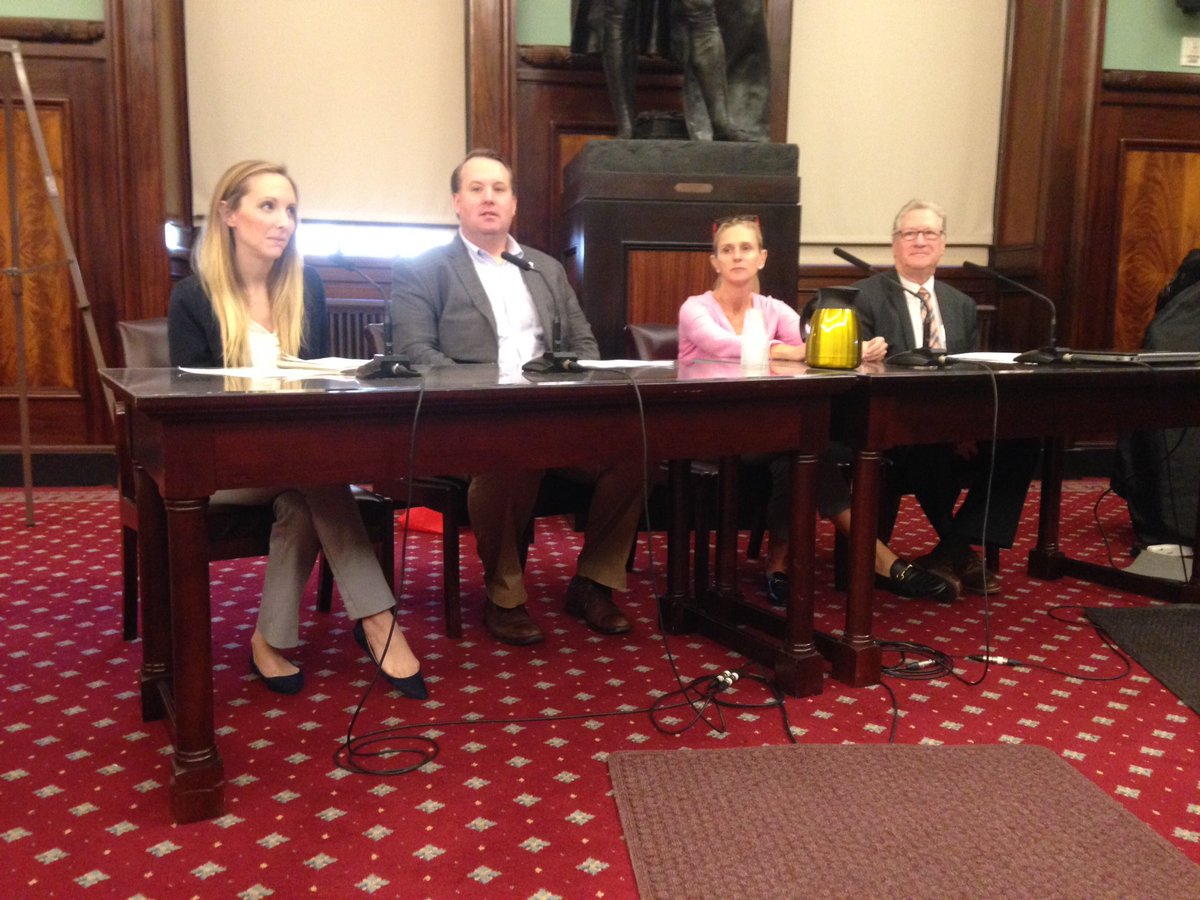
The Department for the Aging recently released “A Survey of Informal Caregivers in New York City” as required by Local Law 97 passed in 2016. The study highlights the difficulties that the estimated 1.3 million unpaid caregivers in New York City experience on a daily basis[1]. From lost earnings to a lack of information about available services, unpaid caregivers, a majority of whom are women, continue to need increased support and resources. More than half of caregivers studied provide at least 30 hours of care each week, and 3 out of 4 caregivers of older adults were over 55 themselves.
It is important to note that these caregivers not only support their loved ones, but New York State benefits an estimated $32 billion annually from these unpaid services[2]. Further, 28% of grandparents in New York City are responsible for raising grandchildren, which significantly alleviates strains on the foster care system and helps to develop the city’s youth.[3] While caregivers are economically supporting the city and state, they are often struggling themselves financially, physically, and emotionally. More can be done to support these invaluable caregivers who reside in every district and make up every race, gender, and socioeconomic status.
Beyond unpaid caregivers, who make up the unseen workforce supporting New York City’s most vulnerable, is a network of services that also provides care, support, and prevention services to seniors. The entire network of services funded by the Department for the Aging are caregiving mechanisms themselves that act as resources and options for unpaid caregivers and their loved ones. For example, social adult day programs offer peace of mind that a senior is looked after in a safe environment so a loved one can remain a part of the workforce; home-delivered meals support homebound seniors who may have nowhere else to turn for a nutritious meal; case management and home care can help a senior avoid the costly move to a nursing home by providing needed assistance with bathing and household chores. The list goes on as senior centers, NORCs, transportation services, and the entirety of the programs funded by the Department for the Aging serve a critical and cost-effective role of supporting New York’s older adults.

With the solvency of the entire system at risk, and a growing population of seniors, it is critical that the administration and City Council continue to invest in, and baseline, these proven effective aging programs and supports specific to caregivers themselves. LiveOn NY supports a fair and equitable budget that supports seniors of all backgrounds in a culturally competent, respectful, and accessible manner.
We look forward to working with our elected officials to ensure that senior and caregiving issues remain a priority and are invested in as such in the coming fiscal year. Thank you again to the New York City Council and the Committee on Aging for the opportunity to testify on the needs of unpaid caregivers.
[1] Department for the Aging, “A Survey of Informal Caregivers in New York City”, 2017.
[2] AARP, 2011
[3] Census Bureau, American Community Survey, 2013

LiveOn NY Study: New York’s Affordable Housing Crisis for Seniors Persists
The number of seniors on wait lists for affordable housing in New York continues to rise as the city gets older, according to a white paper released today by LiveOn NY, an advocacy and policy organization for New York’s community-based aging service providers...
Wait Time Upwards of 10.3 years; Minimum of 19,700 Seniors Languish on Affordable Housing Waitlists on the Upper West Side
Study Conducted in Manhattan Community Districts 7 and 9 — UWS Likely Indicative of City at Large
For Immediate Release
CONTACT: Andrea Cianfrani, Dir. of Public Policy, 212-398-6565x233, acianfrani@liveon-ny.org
New York, NY — The number of seniors on wait lists for affordable housing in New York continues to rise as the city gets older, according to a white paper released today by LiveOn NY, an advocacy and policy organization for New York’s community-based aging service providers.
Highlights from the study:
19,700 seniors are currently on waiting lists in Community Districts 7 and 9 on the Upper West Side. With an overall response rate of 44%, it is estimated that an astounding 44,028 seniors are on waiting lists for affordable housing through the HUD202 program in this neighborhood alone.
Of the seven affordable housing developments which responded to the study, only three were currently accepting additions to their waitlists
With an average wait time of 10.6 years, a senior who signs up for affordable housing at the moment of eligibility—62 years old—will wait on average until he or she is 72.6 for affordable housing.

“This study is proof of something we’ve known for a long time—New York City must continue to expand the stock of affordable senior housing with services, which allow seniors to age in the communities they have helped to build,” said Allison Nickerson, Executive Director of LiveOn NY. “As New York gets older, it is crucial that we direct resources to developing new affordable housing and ensuring that seniors can age with dignity and respect. Our communities must rally around organizations and elected officials who fight to make New York a better, safer city to age in place.”
Approximately 45 affordable units become vacant in the neighborhood each year. With over 19,700 seniors waiting to receive them, the odds of receiving affordable housing have become increasingly bleak. However, the white paper notes that the disparity in affordable housing access would almost certainly be even wider without the work of local and city officials to close the gap—including mayor Bill de Blasio’s efforts to construct or preserve 15,000 units of affordable senior housing as a component of the city’s overall housing plan, and Council Members Mark Levine and Vanessa Gibson’s initiative to ensure that low income tenants have access to a civil lawyer when facing eviction.
Though the study takes place in Community Districts 7 and 9, the organization believes that the findings are indicative of the city at large, where over 200,000 seniors are on waitlists for affordable housing, according to an earlier study.

“Too many of the most vulnerable New Yorkers – especially seniors – are currently facing a staggering affordability crisis in our city,” said New York City Council Member Mark Levine. “New Yorkers have the right to affordable housing, which is why I’m so proud that just this August -- with the invaluable help of advocates like LiveOn NY -- we were able to pass my legislation creating a right to counsel for tenants facing eviction, which will protect tens of thousands for seniors from being unfairly evicted from their homes. However, this report makes it clear there is still much more to do. I look forward to continuing to work with LiveOn NY, and my colleagues such as Council Member Margaret Chin, to make sure the City is doing everything in its power to help the 200,000 seniors currently waiting for affordable housing.”
"This study provides more evidence of a growing crisis that demands tough decisions by elected officials called to represent all of our communities -- not just a privileged few lucky enough to have housing that is safe, accessible and affordable," said Councilwoman Margaret Chin, chair of the City Council's Committee on Aging. "One of the highest callings of the progressive movement is the commitment to caring for the most vulnerable among us. In our drive to be a more fair, equitable and just city, we cannot overlook the growing number of seniors who are still waiting for housing. We have a solemn obligation to these seniors who have contributed, and continue to contribute, so much to the life of one of the greatest cities in the world. It's my hope that this study will be a wake up call for us all that we may never forget this solemn obligation to our elders."
"Thank you to LiveOn NY for shedding light on the extent of the housing crisis in New York City and how it disproportionately affects our seniors. It is unacceptable that as many as 44,000 seniors are currently on waiting lists for affordable housing in Community Districts 7 and 9 on the Upper West Side. My office has assisted hundreds of seniors in danger of losing their homes, which many have lived in for most of their lives, because of soaring property values and the rising cost of living overall. We must protect residents who have been the bedrock of our neighborhoods that we call home. I hope this white paper becomes a galvanizing step toward comprehensive citywide solutions that give our seniors the support they need at the moment they need it most,” said Council Member Helen Rosenthal.

“The numbers tell the story – we need to build much more affordable senior housing,” said Manhattan Borough President Gale A. Brewer. “Stable, multigenerational neighborhoods are one of the cornerstones of a healthy city – we need our seniors, and they need us. Thank you to LiveOnNY for this report and the call to action it provides.”
As the baby boomer generation ages, the city population is skewing older. New York City’s senior population is expected to grow by 47% by 2030, with a growing percentage of seniors preferring to age in place, surrounded by the social networks and supports they have cultivated over a lifetime rather than making the often costly move to a nursing home. These factors will combine to ensure that demand for affordable senior housing continues to grow dramatically citywide.
The study, conducted on the Upper West Side, is part of a larger series on affordable housing that the organization has released over the past few years. In 2016, LiveOn found that 2,000 seniors were on wait lists for affordable housing in nearby Council Districts 6 and 7—with a response rate of 37%, the organization estimated that upwards of 5,406 could actually have been waiting for a spot. The average wait for affordable housing last year was seven years.

$22.9 Million in Baselined Funding Added to DFTA for Senior Services in the Year of the Senior
The final city budget was passed on June 6, 2017. LiveOn NY is thrilled to announce that the Administration/Mayor included a remarkable influx of $22.9 million of baselined funding allocated for the Department for the Aging (DFTA) programs. This is an historic addition of funding and is the most successful increase in 15 years.

YOU did it!
YOU made 2017 the Year of the Senior!
$22.9 Million in Baselined Funding for Senior Services
What is happening?
The final city budget was passed on June 6, 2017. LiveOn NY is thrilled to announce that the Administration/Mayor included a remarkable influx of $22.9 million of baselined funding allocated for the Department for the Aging (DFTA) programs. This is an historic addition of funding and is the most successful increase in 15 years. In addition, City Council allocated over $21 million for senior services, plus additional senior program specific funding through Schedule C allocations.
How does the city provide funding for aging service programs in the budget?
Both the Administration and City Council allocate funding for programs in the annual budget, including funding for DFTA programs.
When the Administration allocates funding, it is typically “baselined” meaning it remains in the budget year after year and becomes part of DFTA’s ongoing operating budget, which was approximately $346 million last year (which includes city, state and federal funding).
City Council’s allocated funding is discretionary and is funded on a year-to-year basis.
For many years, baselined funding for DFTA programs was stagnant, despite the exponentially growing aging population, and in some years there were cuts. These decades of underfunding resulted in growing wait lists for services, senior centers in disrepair, and no community-based safety net for older New Yorkers. This also required City Council to add one-year funding each year for many of DFTA’s core senior service programs like senior centers, case management, home care and others. While this City Council funding was so crucial and so appreciated, it was no way to build the infrastructure to support New York City’s aging population.
That’s why LiveOn NY, along with a strong coalition of aging advocates including AARP, CaringKind, CityMeals on Wheels, Federation of Protestant Welfare Agencies (FPWA), UJA Federation New York and United Neighborhood Houses (UNH) developed a $60.6 million FY18 budget request, specifically calling u pon the Administration to baseline funding for core senior services, so that the funding will continue to build the infrastructure for DFTA programs.
How was the FY18 funding allocated?
FY18 – YEAR OF THE SENIOR
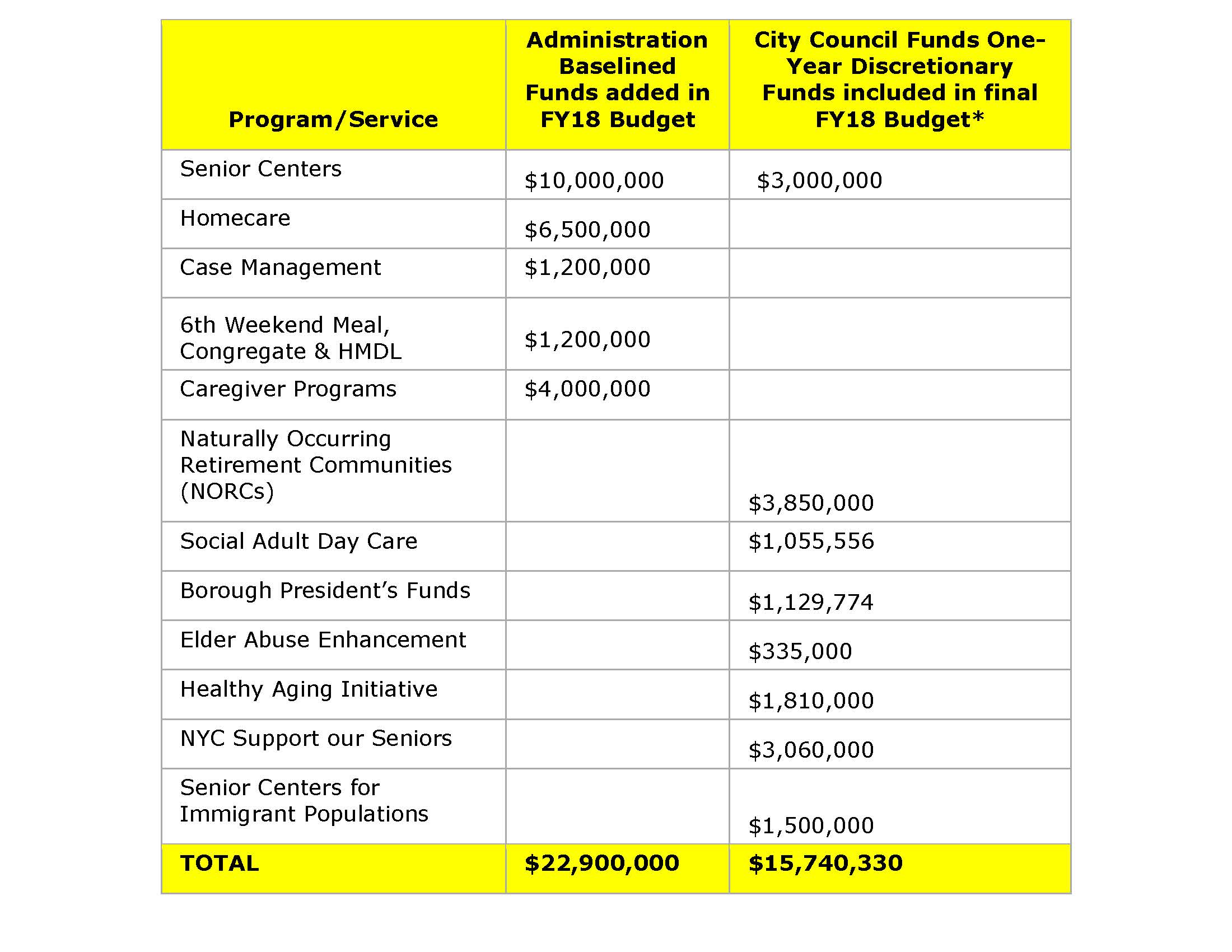
*To see a complete list of all of FY18 City Council funding through Schedule C, click here.
What are some key highlights in the Year of the Senior?
The $4,000,000 for Caregiving Programs is a brand new funding stream, which begins a city investment in caregivers.
Social adult day care received an increase from FY17.
The NYC Support our Seniors funding increased by $1,060,000 from FY17.
The baselined funding for home care and case management is an investment to address the thousands of seniors on waitlists.
In addition, after a very strong campaign led by the Human Services Council (HSC), the city announced additional allocations to “right size” contracts for human services organizations. According to the HSC budget statement statement, the FY18 budget included the following provisions: "$88 million to bring indirect cost reimbursement rates to 10 percent over five years, beginning with a $17.6 million investment this year; $22.7 million to support a model budget process that will address salary disparities for preventive services, senior centers, services for runaway and homeless youth, and adult protective services, with plans for additional model budget processes in fiscal years 2019 and 2020; and $90 million to fund cost-of-living adjustments for the human services workforce at a rate of 2 percent per year over the next three years remains." Council Member Helen Rosenthal was also strong advocate for these issues.
How did we make this the Year of the Senior? It was a TEAM effort!
Last summer, City Council Aging Chair Margaret Chin declared 2017 the Year of the Senior, setting the stage for year- long advocacy campaign. Council Member Paul Vallone, Chair of the Subcommittee on Senior Centers, also worked closely with Council Member Chin in these efforts. City Council staff members were also instrumental in this important work.
Seniors citywide and LiveOn NY members sent an astounding total of 22,000 letters to the Mayor, Speaker and Council Members urging them to fund senior services. Click here to see a list of the organizations that took part in the letter writing campaign. Over 350 seniors also attended Advocacy Day at City Hall in May, and hundreds more also attended hearings, made calls, held events at their centers and programs and advocated year round showing the amazing momentum seniors provide to this city.
DFTA Commissioner Donna Corrado was a strong advocate for the importance of investing in senior services across the spectrum, from senior centers, to meals, to home care, to mental health services for elder abuse victims, to case management and other programs.
All City Council Members and staff, under the leadership of Speaker Melissa Mark-Viverito and Finance Committe Chair Julissa Ferreras-Copeland, staunchly advocated for senior services in hearings and meetings in the Year of the Senior and also included the aging advocates' $60.6 million budget request in the Council Budget Response.
Mayor de Blasio and the Administration listened to and clearly heard the importance of investing in seniors.
The coalition of aging advocates along with LiveOn NY member agencies worked year round to advocate for this funding, holding briefings, attending hearings, holding hundreds of meeting with City Council and the Administration, press conferences and other events to talk about the incredible momentum seniors provide to the city and how important it is to invest in aging services.
What’s next?
Today we celebrate – but our work is not done. We will continue to advocate to make each year the Year of the Senior. Stay tuned for Action Alerts and news so that you can stay involved in our efforts.
Contact Bobbie Sackman, Associate Executive Director of Public Policy at 212-398-6565 x226 or bsackman@liveon-ny.org or or Andrea Cianfrani, Deputy Director of Public Policy at acianfrani@liveon-ny.org or 212-398-6565 X233