

News
&
Updates

State Testimony at Joint Budget Hearing on Human Services
Currently, more than 11,500 older adults are on waiting lists for State Office for the Aging (SOFA) community based services, particularly waiting lists for home-delivered meals, case management, home care, and transportation that have arisen throughout the COVID-19 pandemic. Such services enable older adults in counties across New York to age safely and independently in their communities, avoiding unwanted moves to costlier institutional care settings. This is likely the tip of the iceberg in regards to demand across the state, as federal stimulus funds have helped keep larger waiting lists at bay, and the mere presence of a waiting list is often untenable for an older adult in need, forcing the individual to make the immediate decision to enter an institutional setting.
We’re proud to testify to the New York State legislature to ensure that the strengths, as well as the needs, of older adults are consistently heard and prioritized by New York’s elected officials. Below is testimony submitted by LiveOn NY at the Joint Legislative Public Hearing on 2021 Executive Budget Proposal: Topic Human Services.
Support the budget asks included in the below testimony?
Call your Senate and Assembly representatives and echo the funding asks most meaningful to you.
State Assembly Representatives
State Assembly Representatives or Assembly Switchboard 518-455-4100.
State Senate Representatives
State Senate Representatives or Senate Switchboard 518-455-2800.
New York State
Joint Legislative Budget Hearing
Human Services
February 9, 2021
My name is Katelyn Andrews and I am the Director of Public Policy at LiveOn NY. Thank you to both the Senate and the Assembly for the opportunity to testify today.
LiveOn NY’s members include more than 100 non-profit community-based organizations that provide core services to older adults across the State. These programs include senior centers, home-delivered meals, affordable senior housing with services, elder abuse prevention services, caregiver supports, NORCs, case management, and homecare. Through policy efforts, LiveOn NY, with our members, advocates to make New York a better place to age.
LiveOn NY also administers a citywide benefits outreach program that assists thousands of older adults each year in communities where benefits, such as SNAP and SCRIE, are most underutilized. Additionally, thanks to the generous support of the legislature, LiveOn NY administers the Rights and Information for Senior Empowerment (RISE) program, an outreach program designed to support professionals serving older adults and offer direct assistance and information to older New Yorkers.
In all, we believe that aging creates momentum that drives our state forward, with older adults powering local economies, political systems, and communities. Older people are the anchors in our neighborhoods, providing invaluable volunteerism, caregiving, and civic engagement across the state.
Unfortunately, despite older New Yorkers being an asset to our state, they have not been invested in. Today, New York’s older adult population is greater than the total populations of 21 other states, yet it isn’t reflected in the New York State Office for the Aging (NYSOFA) budget. New York State’s older adult population is more than 1.6 million with the Executive Budget allocating NYSOFA only $271.6 million in aging funding, $3.12 million less than in Fiscal Year 2020-2021, amidst a global pandemic in which seniors have been hardest hit.
While the older adult population continues to be the fastest growing demographic, and despite seniors having been particularly vulnerable to the impacts of COVID-19, the programs that are built to serve older New Yorkers remain chronically underfunded, even more so than last year given the cuts and lack of accounting for inflation and increased demand. This pervasive underfunding of NYSOFA has real implications for our ability to keep older New Yorkers safe in communities through a global pandemic. Illustrative of this, is the existence of waiting lists for services that deter the need for higher levels of care, in settings that proved particularly vulnerable to the virus. This further represents a missed opportunity to find cost-savings that would otherwise be imposed at higher levels on our Medicaid and Medicare systems.
It is important to illustrate just why increased support for senior services is so critical to New York State’s ability to further assert itself as a bastion of progressive policy. There is a reason that one in seven older adults are living in poverty throughout New York State, time acts as a compounding factor to inequities experienced throughout the life course. For an older woman of color, decades of earning less per dollar than their male counterparts compounds to inadequate savings to make ends meet when she reaches old age. Evidence to this, today, 19% of African American seniors live in poverty. For an LGBTQ senior, closed doors due to discrimination in the workplace or in housing, compound fiscal insecurity throughout a lifetime. Today, one in five LGBT adults are living on less than $12,000 a year. For an older Chinese immigrant, linguistic isolation and a lack of access to benefits lead to limited resources in old age. Today, Chinese seniors in New York City have an estimated annual income of $7,000 a year, a number not vastly different from other older immigrant populations. For all seniors, of whom the average social security payment is only $1,470 a month, we as a state must do more to, at the very least, provide high quality services for all older New Yorkers to redress such vast inequities in old age.
These inequities were reflected in the impacts of COVID-19. Data from the CDC highlights this, with Black and brown Americans representing 30% of COVID cases, despite accounting for only 13% of the population. Black workers made up a significant portion of the frontline workers deemed essential throughout COVID-19, placing these individuals and their families at greater risk throughout the pandemic. Consequently, hospitalizations and deaths due to COVID disproportionately affected people of color all over the country. The COVID-19 pandemic further exposed the ongoing racial inequities that were already prevalent.
To begin to address such inequities, the following represents LiveOn NY’s Fiscal Year 2021-2022 budget recommendations:
Fund Services for the more than 11,500 Older Adults on Waiting Lists
Budget Ask: A significant investment towards the $27 million needed to fully address waiting lists
Currently, more than 11,500 older adults are on waiting lists for State Office for the Aging (SOFA) community based services, particularly waiting lists for home-delivered meals, case management, home care, and transportation that have arisen throughout the COVID-19 pandemic. Such services enable older adults in counties across New York to age safely and independently in their communities, avoiding unwanted moves to costlier institutional care settings. This is likely the tip of the iceberg in regards to demand across the state, as federal stimulus funds have helped keep larger waiting lists at bay, and the mere presence of a waiting list is often untenable for an older adult in need, forcing the individual to make the immediate decision to enter an institutional setting.
Given the exorbitant strain COVID-19 has placed on the older adult population, the prospect of adding further stress to the lives of older New Yorkers by forcing them to wait for critical services is untenable and must be redressed through a significant, immediate investment. For many older adults, it is only through the delivery of a daily hot meal, a visit from a home care attendant to assist with activities of daily living, or the support and referrals from a case manager, that one is able to live fully and safely in community. To delay a single older adult from getting such support—particularly during a global pandemic that has left older New Yorkers most at risk—is to deny them the opportunity to age with dignity and respect. We as a State must ensure that funds are available to address this waiting list, not only for the older adults in need, but for the non-profit community-based service professionals who so desperately wish to serve but lack the funds to do so.
Further, by investing in these supports, New York will not only be ensuring an improved quality of life to those in need, but will inevitably help balance the State’s budget by reducing Medicaid expenditures. Findings indicate that for every 1% increase in home-delivered meal service to the older adult population, there is a significant savings to Medicaid through the reduction of higher cost care. More specifically, findings indicate that in New York, savings from just a 1% increase in meal service would lead to $11,427,143 Medicaid savings—proving that waiting lists for such services actually cost more than the cost of the meal service itself.
Ensure Older New Yorkers and Professionals Have Access to Key Information
Budget Ask: Restore $200,000 in historically legislative funding for LiveOn NY’s “Rights and Information for Senior Empowerment” (RISE) program
The Governor’s Budget eliminated $200,000 in funding for LiveOn NY’s RISE program. This cut will put at risk our ability to ensure that older New Yorkers receive vital information regarding COVID resources, benefits and entitlement changes, scams, and ways to remain active and safe. The timing of this move is particularly distressing as COVID-19 has had a disproportionately deadly impact on older New Yorkers, who have also faced new and frequently daunting barriers when trying to access meals, groceries, medicine, support services, and now the COVID vaccine. Even prior to the pandemic, older adults have often struggled to receive basic, trustworthy information on how to get vital services, including benefits such as SNAP and SCRIE, which LiveOn’s RISE program works tirelessly to promote and make accessible for older adults.
At this critical juncture, LiveOn NY seeks a restoration of funding to bridge these gaping information holes through a multi-faceted approach. This approach will include:
Providing citywide training and education for the senior service workforce (primarily through virtual techniques that LiveOn successfully implemented during the lockdown and beyond), so that they know about benefits, programs, and services, as well as how to best help their clients on such matters.
Serving as a “constituent services” partner with local elected officials’ offices to bring needed information to the community (e.g. through information for elected officials’ newsletters, webinars, and other communications efforts).
Provide updated, free, culturally competent information to seniors, including through digital methods (including LiveOn’s website, social media, and newsletters), as well as extensive engagements with a variety of media sources.
Restore Funding to Combat Elder Abuse
Budget Ask: Restore $340,000 in funding for Lifespan and the NYS Coalition on Elder Abuse
Lifespan is the convener of the New York State Coalition on Elder Abuse and works to provide training, public awareness, and direct social work intervention in all forms of mistreatment, with an emphasis on financial exploitation—the fastest growing form of abuse and often the most devastating for vulnerable older adults. New York State is a leader in the field because of the decades-long support in the State Budget.
The Governor’s Executive Budget proposal eliminated $340,000 in funding for Lifespan. These funds are critical for our overall ability to address elder abuse prevention & intervention throughout New York State. This service is particularly important during COVID-19 as the pandemic has led to: an increase in scams nationwide; the potential for increased proximity of perpetrator to victim due to more individuals “staying home;” and growing economic challenges nationwide that may increase a perpetrators willingness to commit financial abuse.
More specifically, these funds provide services to combat elder abuse such as, case management, education and intervention, shelter for victims, respite for caregivers, statewide education and training, statewide multidisciplinary teams, forensic accounting in cases of financial exploitation, statewide financial exploitation consultation, and management of the New York State Coalition on Elder Abuse.
Increase funding for the Long-Term Care Ombudsman Program
Budget Ask: Increase the program budget by $4.81 million
The Long Term Care Ombudsman Program (LTCOP) is an advocate and resource for older adults and persons with disabilities who live in nursing homes, assisted living and other licensed residential facilities. The importance of this program was seen during the COVID-19 crisis. Throughout this pandemic, the LTCOP staff and volunteers have remained engaged with residents, families, and facilities to provide information and support to ensure that resident rights are protected but, without access, it was hard. Older adults in long-term care have proven the most vulnerable and the most at-risk. If fully supported, ombudspersons can act as advocates and sources of strength on behalf of increasingly distraught family members seeking information about their loved one. It is time to modernize and strengthen this critical program.
Today ombudspeople help residents understand and exercise their rights to good care in an environment that promotes and protects their dignity and quality of life. The program advocates for residents at both the individual and systems levels to address issues that have the potential to impact their health and wellness. Ombudspeople investigate and resolve complaints; promote the development of resident and family councils; and inform government agencies, providers and the public about issues and concerns that impact facility residents. Ombudsmen’s activities also greatly enhance the footprint of DOH facility surveillance activities by sharing resident concerns and quality of care issues observed during regular interactions with residents.
Support Naturally Occurring Retirement Communities (NORCs)
Budget Ask: Restore $325,000 in historically legislative funding
We are pleased that the Governor’s Executive Budget proposal includes $8.055 million in support for NORC programs, but unfortunately, it fails to include $325,000 that the Legislature added in FY 2019-2020 and FY 2020-2021 to support nursing services in NORCs. Restoration of this funding is critical as it enables NORCs to provide key nursing services to older residents in need. During COVID-19 in particular, despite physical NORC spaces being closed, staff have continued to assist residents remotely throughout the pandemic, including through: frequent wellness calls to monitor health and safety and to reduce social isolation; case management services to assist older adults in accessing food, medical supplies, in-home healthcare, and more. NORC nurses are providing remote support over the phone, particularly focusing around COVID-19 concerns. In this remote environment, NORCs serve as essential services for older adults, helping them stay safe, healthy, and connected.
Invest in Affordable Senior Housing & the Empire State Supportive Housing Initiative (ESSHI)
Budget Ask: Commitment to a new $3 Billion investment over 5 outyears towards Affordable Housing Capital, including affordable senior housing and service coordination for older residents
LiveOn NY supports the Governor’s Executive Budget commitment to another year of supportive housing through a $250 million investment, as well as the commitment to extend low-income housing credits for five years. However, as we are now in the final year of New York State’s Five-Year Housing Plan yet the need is greater than ever. It is important for the state to signal a commitment to consistent, predictable funding to maintain a pipeline of production, including for critical senior and supportive housing projects.
Deepening investments in affordable senior housing with services is critical in future years, not only to improve the quality of life of older New Yorkers and address rising senior homelessness, but as a cost-savings measure against increased Medicaid and Medicare spending. Service coordinators in senior housing residences have proven to reduce health care costs, including reducing Medicaid expenditures. LiveOn NY’s member, Selfhelp Community Services, released a study of the residents in their senior affordable housing program. The study compared Medicaid data for residents in their housing in two zip codes to other seniors living in the same zip codes over two years. This research found that seniors living in Selfhelp’s affordable housing had demonstrably positive outcomes including:
68% lower odds of being hospitalized
$1,778 average Medicaid payment per person, per hospitalization for Selfhelp residents, versus $5,715 for the comparison group
53% lower odds of visiting an emergency room compared to a non-resident
Additionally, a 2016 study of residents in affordable housing in Oregon showed that Medicaid costs declined by 16% just one year after seniors moved into affordable housing communities. Results also showed that primary care visits increased by 20%, while emergency room visits decreased by 18%, and that properties with on-site health services produced the largest decrease in emergency room visits. These examples demonstrably show that an investment in service coordinators makes good fiscal sense, while supporting older New Yorkers.
Invest in Technology for Older New Yorkers
Budget Ask: $5 Million in funding to invest in technology services for older adults
COVID-19 has shown the vast digital divide in the older population. The most vulnerable older residents have been without interaction for months, and having the ability to create and implement a robust virtual platform for our clients is paramount. There needs to be a substantial investment to purchase and implement technology to bridge the gap in social isolation and loneliness. Our network stands prepared to implement a variety of programs, including expanding virtual senior centers across the state, with an investment.
In Conclusion
In this difficult budget year, we are especially proud to recommend investments with proven cost-savings to Medicaid and health care more broadly, while remaining quality and mission-driven in approach. We appreciate the legislature's support of the above recommendations and look forward to seeing a budget that responds to the devastating impact COVID-19 has had, and continues to have, on the older adult population. LiveOn NY stands ready to work with New York State to make New York a better place to age, and we appreciate all efforts by the State to provide equity, reduce wait lists, and improve quality of life for all older New Yorkers. Thank you again for the opportunity to testify.

LiveOn NY Statement on the COVID-19 Vaccine Distribution Across New York State
The vaccine distribution in New York continues to reveal the gaps as older New Yorkers of color are less likely to have access to the internet and technology and yet, we as a State, as a City, and in counties across New York, continue an over-reliance on the use of technology to distribute information and access to this life saving vaccine.
For Immediate Release
NEW YORK — February 2, 2021 — The time for bold commitment to New York’s older adults — particularly people of color who have shouldered the brunt of the COVID-19 pandemic — is now. Older New Yorkers of color are disproportionately impacted by the pandemic with higher mortality rates and a growing need for critical services, exposing the racial disparities and inequalities that already plague communities of color. The vaccine distribution in New York continues to reveal the gaps as older New Yorkers of color are less likely to have access to the internet and technology and yet, we as a State, as a City, and in counties across New York, continue an over-reliance on the use of technology to distribute information and access to this life saving vaccine.
The lack of coordination with community-based organizations that are often sources of trust to marginalized populations, widen the gap in the vaccine distribution. Black and brown residents, who represent 22% of the City’s population, have only received 9% of the vaccines. While laudable steps have been taken to create hotlines or prop up vaccination in sites such as NYCHA, for too many older New Yorkers, the vaccine remains inaccessible, trapped behind a labyrinth of websites or behind hold-music with no end in sight.
To the extent that these experiences are the result of supply failures, we look now to the new Biden Administration to expedite production and ensure our vaccine supply chains are steady into the future.
To the extent that the decentralization of this system, the over-reliance on technological mechanisms for vaccine access, the lack of information across languages are the result of decisions made by our counties and our state, and the underutilization of community-based nonprofits to promote access, we call on each level of government to remove these barriers swiftly and fully, while deepening engagement with these community assets.
Vaccine accessibility by mobility must also be prioritized, and a plan for the vaccination of homebound older New Yorkers must be urgently developed and implemented.
We also call on the State and localities to make publicly clear that all professionals working with older adults are eligible for the vaccine. While nursing homes were appropriately prioritized in initial phases of vaccine distribution, it is time to fully acknowledge and appreciate that most older New Yorkers live in communities often with the support of caring human services professionals such as home-delivered meal cooks and deliverers, service coordinators and maintenance workers in senior housing, home care attendants, and caregivers who are the unseen, underappreciated heroes throughout this pandemic. To support these professionals, New York governments must not only make clear their eligibility for the vaccine, but must fully fund their work.
The time to rise to the challenge is now. With the appropriate guidance and partners, entire buildings of senior housing could swiftly and equitably vaccinate thousands of older New Yorkers at scale. There are trusted community nonprofits, armed with the right information and infrastructure, could dispel myths and ensure vaccination across the hardest to reach populations as well as hundreds of thousands of loved ones who, compelled by the efficiency of a government that moves to truly meet people where they are, will breathe a sigh of relief if we get this right.
LiveOn NY, and our members, stand at the ready to support New York in fulfilling an equitable, efficient, and expedient vaccination program.
Press Contact
Brianna Paden-Williams, Communications and Policy Associate, bpaden-williams@liveon-ny.org
About LiveOn NY
LiveOn NY’s members provide core community-based services that allow older adults to thrive in their communities. With a base of more than 100 community-based organizations serving at least 300,000 older New Yorkers annually. Our members provide services ranging from senior centers, congregate and home-delivered meals, affordable senior housing with services, elder abuse prevention services, caregiver supports, case management, transportation, and NORCs. LiveOn NY advocates for increased funding for these vital services to improve both the solvency of the system and the overall capacity of community-based service providers.
LiveOn NY also administers a citywide outreach program and staffs a hotline that educates, screens and helps with benefit enrollment including SNAP, SCRIE and others.

LiveOn NY Testifies at Joint Aging and Technology Hearing
Throughout the pandemic, LiveOn NY’s members and the entire aging services network have found new ways to provide critical services to older New Yorkers in the face of unprecedented demand and a public health crisis. Technology has been the core to making this work possible. Overnight Senior Center classes went virtual and phone calls became the main mode of communication with clients. This work is critical, as isolation is now understood to be a significant health risk and predictor of morbidity. The ability to remain connected virtually has undoubtedly saved lives.
We’re proud to testify to the New York City Council to ensure that the strengths, as well as the needs, of older adults are consistently heard and prioritized by New York’s elected officials. Below is testimony submitted by LiveOn NY to the New York City Council Committees on Aging and Technology.
To learn more about upcoming New York City Council hearings: click here. To register to testify: click here. To watch live and past hearings: view here!
New York City Council
Committee on Aging
Chair, Council Member Chin
Committee on Technology
Chair, Council Member Holden
January 22, 2021
Oversight - Increasing Senior Access to Technology
Thank you for the opportunity to testify on increasing senior access to technology.
LiveOn NY’s members include more than 100 community-based nonprofits that provide core services which allow all New Yorkers to thrive in our communities as we age, including senior centers, home-delivered meals, affordable senior housing, elder abuse prevention, caregiver supports, NORCs and case management. With our members, we work to make New York a better place to age.
Throughout the pandemic, LiveOn NY’s members and the entire aging services network have found new ways to provide critical services to older New Yorkers in the face of unprecedented demand and a public health crisis. Technology has been the core to making this work possible. Overnight Senior Center classes went virtual and phone calls became the main mode of communication with clients. This work is critical, as isolation is now understood to be a significant health risk and predictor of morbidity. The ability to remain connected virtually has undoubtedly saved lives. To showcase the breadth of virtual programming that is now available, LiveOn has created a webpage where older adults can find classes offered in their community or that focus on their interests.
Unfortunately, the FCC estimates that 21 million Americans do not have access to high-speed internet, while other studies believe that number is closer to 42 million people. Even in New York, there are areas where connectivity remains a challenge. Additionally, financial barriers hinder access to technology among older adults, particularly given that the majority of older adults rely on limited fixed incomes. Today, many seniors can’t afford to purchase technology such as tablets or computers, and even if the devices are given to them, it is difficult or impossible to afford monthly internet access. Further, the COVID-19 pandemic has exacerbated the digital divide, brought increased awareness to its existence, and highlighted the disastrous effects of not combatting its prevalence.
Encouragingly, both the City and the State are beginning to address this issue. For example, the City’s tablet distribution program is a concrete step towards improving access to technology, and Governor Cuomo recently announced intent to “mandate $15 per month high-speed service for low-income families” guaranteeing “affordable internet for all low-income families.” LiveOn NY encourages the state to ensure program eligibility that is inclusive of low-income older New Yorkers.
Although efforts have been made to increase senior access to technology from the start of the pandemic until now, and while Mayor de Blasio initially promoted tech access through his “Internet Master Plan,” more must be done. LiveOn NY and our members have seen the ways that lack of access to technology limits the ability for older adults to remain engaged and connected in our communities. For example, lack of access limits one’s ability to connect to virtual programming, thereby heightening the risk of isolation. Further, lack of access means missing out on real time information, such as best practices in regards to COVID, how to access food or the vaccine, online job opportunities, and even the ongoing political discourse that often happens through the web.
One of LiveOn NY’s members, PSS, surveyed more than 700 older adult participants, and found lowest tech use and comfort among their Senior Center program attendees, with many having no personal means to access the internet, whether it be through WiFi or cell service. Many clients reported having only a basic cell phone as their technology infrastructure. These findings underscore and support the urgency of the following recommendations, aimed at combating the digital divide:
City
Increase funding. Utilizing new technologies, Senior Centers have kept tens of thousands of seniors safe, connected, and healthy during the pandemic, despite operating on a shoestring budget. It is critical that Centers have a strong technology infrastructure to further enable Senior Centers and other DFTA programs to connect with older adults through virtual programming, during the pandemic and beyond.
LiveOn NY recommends that the City increase its investment in the technology infrastructure of Senior Center and other DFTA providers.
Fulfill the commitment to allocate $10 million annually to Senior Centers, a promise that was neglected to be fulfilled in FY21, which would expand Senior Center funding to support the type of virtual programming made possible during this time.
Fully fund the Indirect Cost Rates (ICR), which not only ensures the viability of the nonprofits providing these services, but often covers software and data systems that enable programs to perform in an increasingly virtual world.
Prepare for reopening. As Senior Center spaces remain closed, the Centers’ computer rooms which often are the sole point of access to technology for older adults are closed as well.
The City must critically evaluate and share its timeline to reopen Senior Center spaces, as well as provide guidance on how to operate congregate spaces, such as computer labs, safely in the future.
Promote tech literacy among older adults. It’s important to keep in mind that of the older adults who have internet access, nearly half require assistance to use the internet or to set up their new device, and many are reliant on family for this support. This is why it is important to not only support tech expansion, but to support organizations that promote technology literacy among older adults.
The City should look to broaden and fund collaboration with Senior Centers, and organizations such as Senior Planet, which offers a hotline and courses to broaden tech access among older adults.
Make City resources accessible no matter a person’s tech literacy. As we have seen from the vaccine distribution, too often, an over-reliance on technologically rooted outreach and enrollment systems can lead to barriers in access for those who are not tech savvy. This can no longer be an afterthought. Just as the City should work to make all of its services available in multiple languages, so should it prioritize accessibility on the basis of technology literacy, or lack thereof. Non-tech options can no longer be second tier, meaning a phone option that is being utilized for seniors unable to register for the vaccine through the web, can not yield unreasonable hold times or other barriers. Whether it be sharing information around vaccine distribution, SCRIE eligibility or new senior units available on Housing Connect, removing barriers to access City resources will undoubtedly make New York a better place to age.
At the outset of all initiatives, the City must consistently implement multi-pronged outreach efforts that utilize both technology and non-tech outreach and engagement methods.
State
LiveOn NY requests City Council utilize its platform to call on Governor Cuomo to sign the Comprehensive Broadband Connectivity Act (A.6679C Ryan/S.8805 Metzger). This legislation directs “the public service commission to review broadband and fiber optic services within the state and requires the expansion of broadband and fiber optic services.” By understanding and working to expand broadband and fiber optic services, New York will promote equity and equal access to information across the state for individuals of all ages. Enacting this legislation will support Governor Cuomo’s goal of increasing broadband access across the state.
Federal
Expand distribution of tech resources. LiveOn NY is incredibly appreciative of the City’s investment in 10,000 tablets for older NYCHA residents, an initiative funded by utilizing federally allocated community-development block grants (CDBG), which are flexible in nature. This distribution program should be expanded to further meet the need that exists, and to share any data received on the impact of this initial investment to date.
Fully utilize federal resources. Within the most recent stimulus package, there has been new funding allocated for broadband infrastructure; notably, $7 billion for expanding access to high speed internet access.7 The City must evaluate this funding and ensure that it is prepared and well positioned to access these new resources.
Thank you for the opportunity to testify at today’s hearing.

A Goodbye to 2020: LiveOn NY’s End of Year Recap
2020 was a year like no other. The COVID-19 pandemic swept across communities, creating a rippling effect that exposed the current political, economic and social gaps that impact older New Yorkers including access to affordable senior housing, food insecurity, the rise of social isolation due to the pandemic and inadequate funding for vital senior services. Yet despite the challenges, organizations and providers have worked tirelessly to make New York a better place to age and ensure older adults have the support they need to truly thrive in New York. Here, we look back at some of our top moments from LiveOn NY and our community in 2020.
2020 was a year like no other. The COVID-19 pandemic swept across communities, creating a rippling effect that exposed the current political, economic and social gaps that impact older New Yorkers including access to affordable senior housing, food insecurity, the rise of social isolation due to the pandemic and inadequate funding for vital senior services. Yet despite the challenges, organizations and providers have worked tirelessly to make New York a better place to age and ensure older adults have the support they need to truly thrive in New York.
Here, we look back at some of our top moments from LiveOn NY and our community in 2020.
Beyond Bricks: Affordable Senior Housing Symposium

Council Member Cornegy Jr, Council Member Salamanca Jr, Public Advocate Williams, & Scott Short on a panel at the Beyond Bricks: Affordable Senior Housing Symposium
LiveOn NY hosted the Beyond Bricks: Affordable Senior Housing Symposium on February 25, the largest event in New York City to focus on both aging and housing. This event brought together housing developers, management companies, elected officials, community-based nonprofits, and other representatives from public, private, and governmental organizations within the housing and aging services industries.
LiveOn NY also released a new report, Beyond Bricks: Affordable Senior Housing with Services, that highlights the various types of affordable senior housing models throughout the city as well as targeted recommendations to ensure older adults can age in place with accessible and affordable senior housing with services.
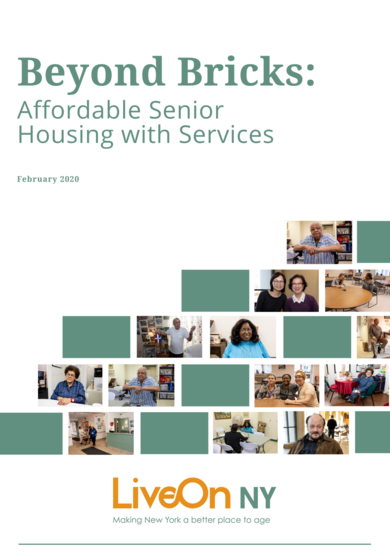
LiveOn NY’s report, Beyond Bricks: Affordable Senior Housing with Services
LiveOn NY Hit the Frontlines Working to Provide Home Delivered Meals, Personal Care Kits and Other Key Benefits to Older New Yorkers in Need
LiveOn NY’s Benefits Outreach team, along with our member organizations were among the frontlines during the pandemic, providing critical support to older adults. The need for benefits and outreach skyrocketed with LiveOn NY’s team assisting over 2,300 adults with screening and enrollment assistance for key benefits including SNAP, the Rent Freeze Program, HEAP and other benefits as well as outreach to over 200,000 older New Yorkers to spread awareness about these supports.
When the city shut down went into effect, many older adults were unable to leave their homes or travel to grocery stores. Food security was on the rise in communities as more older adults were homebound. To meet the growing need for food, LiveOn NY, in partnership with the Project Isaiah and the World Central Kitchen, coordinated the delivery of 279,599 meals to older New Yorkers. In addition, our team organized and coordinated with community partners to provide 32,000 cold packs of food and 10,000 personal care kits to older adults in communities hit the hardest by the COVID-19 pandemic thanks to the generous support from the NYC COVID-19 Response & Impact Fund of the New York Community Trust.

Picture courtesy of our member and partner in the distribution of meals, Chinese-American Planning Council.
Shifting to a Virtual Space
Across New York, organizations and providers have shifted to virtual programming due to the pandemic, offering critical services through online platforms for older adults and caregivers. LiveOn NY launched the Senior Center Workshop Initiative, a series of virtual workshops on innovative approaches for aging services and senior center operation to identify the barriers organizations face and meet the growing needs of aging services.
We also launched our Boots on the Ground Workgroup, a bi-weekly Zoom meeting for all aging service professionals to hear from leading experts on relevant topics, share resources and ideas, practice self-care, and other activities.
LiveOn NY’s 25th Annual Virtual Aging Advocacy Day
Each year, hundreds of older adults and aging services professionals have taken to the steps of City Hall to demand their fair share of the budget. While we weren’t able to gather in-person for the 25th Annual Aging Advocacy Day, over 200 people including elected officials, aging services professionals, advocates, and older adults gathered virtually for a TeleRally to discuss the needs of the aging services network as well as highlight the work of providers and organizations that continue to serve older New Yorkers during these challenging times.
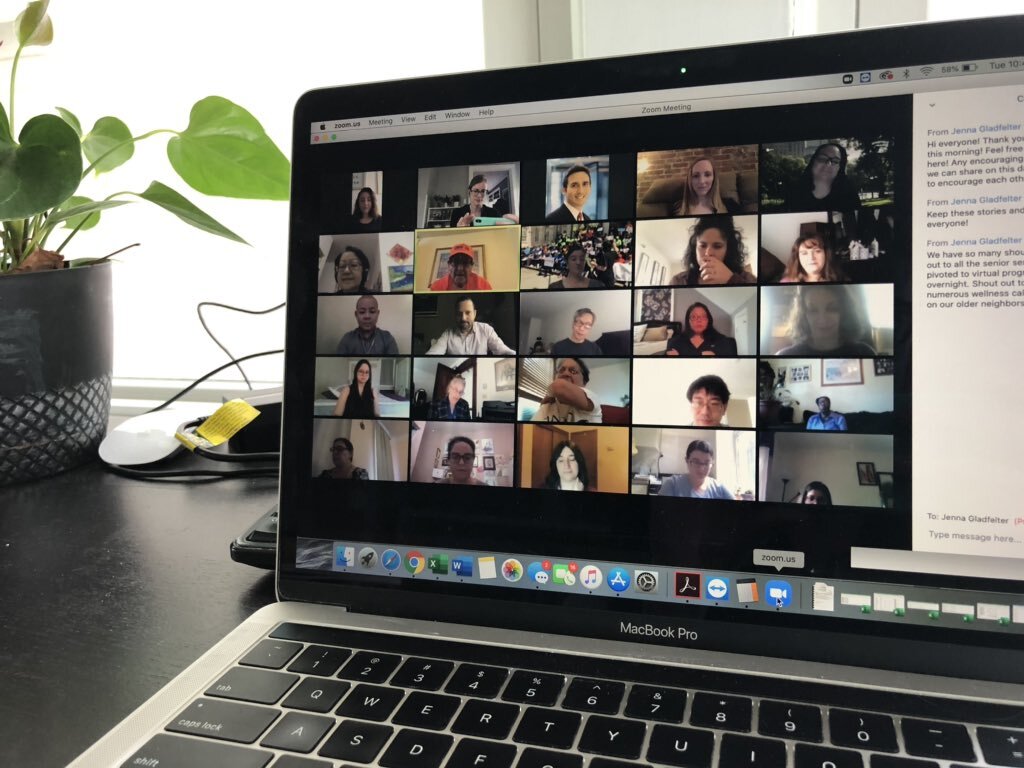
LiveOn NY hosted a virtual Aging Advocacy Day with a TeleRally on Zoom
Historic Advocacy Win: Bills Passed to Fight Age-Discrimination
Ageism, the discrimination against an individual based on their age, is a reality that impacts older New Yorkers every day, especially in the workplace. The New York City Council passed a historic package of bills, sponsored by Council Members Margaret Chin and Diana Ayala, to fight age discrimination in the workplace. LiveOn NY was proud to advocate in support of this legislation and work towards its enactment alongside partners at AARP New York, the Hunter Brookdale Center for Healthy Aging, and the New York State Alliance for Retired Americans.
Restoration of $466 million in Affordable Housing Funding
On October 23, Mayor Bill de Blasio announced the city will restore $466 million in the 2021 fiscal year’s capital cut to advance New York City’s Housing Plan. This advocacy win was made possible through the #NoCapitalCuts Campaign led the New York Housing Conference. LiveOn NY and other stakeholders and member organizations also joined the campaign and signed on to the letter to ensure New Yorkers have access to affordable housing.

Looking Ahead
As we close a chapter in 2020, we want to take a moment to express our gratitude and appreciation for our LiveOn NY community and beyond, who continue to show up every day to support older adults through vital services and programs. As we look ahead into the new year, LiveOn NY will continue to support our members and older New Yorkers to create a better future to age.
Follow us on Twitter and Facebook @LiveOnNY

158 Organizations Urge Governor Cuomo to Address Statewide Waiting Lists for Services for Older New Yorkers
158 organizations that provide services to older New Yorkers and their caregivers are calling on Governor Andrew Cuomo to address in his next state budget proposal a growing waiting list of more than 11,000 older New Yorkers who qualify for but are not receiving vital services such as home-delivered meals, home care, and case management.
Media Contacts:
Erik Kriss (AARP), ekriss@aarp.org 518-360-9213
Katelyn Andrews (LiveOn NY), kandrews@liveon-ny.org (609) 458-6294
Becky Preve (Assoc. on Aging NY) becky@agingny.org (518) 570-6023
Ann Marie Cook (Lifespan), amcook@lifespan-roch.org, (585) 244-8400
158 Organizations Urge Governor Cuomo to Address Statewide Waiting Lists for Services for Older NYers
Pandemic Increases Need for More Vital Services Such as Home-Delivered Meals and Home Care
FOR IMMEDIATE RELEASE:
ALBANY, N.Y. - 158 organizations that provide services to older New Yorkers and their caregivers are calling on Governor Andrew Cuomo to address in his next state budget proposal a growing waiting list of more than 11,000 older New Yorkers who qualify for but are not receiving vital services such as home-delivered meals, home care, and case management.
The organizations recognize Governor Cuomo’s leadership over the last two years through significant State investments in services for older New Yorkers; these can help forestall the need for mostly unwanted moves to costlier and mainly taxpayer-funded nursing homes and other institutional care settings.
COVID-19 has dramatically changed the landscape, and the need for aging services has skyrocketed since the pandemic began, the broad array of groups said in a letter to the Governor (see full letter below) in which they called these serviced a “morally-urgent and strategically cost-effective investment.”
The number of seniors waiting for case management services in New York City skyrocketed by 265% between February and August, according to LiveOn NY. In addition, the need is particularly acute among older New Yorkers of color, with new research finding 39% of Black families and 37% of Hispanic families struggling with food insecurity, compared to 25% of the population at-large.
The groups are specifically asking for increased funding for the New York State Office for the Aging (NYSOFA), which administers many in-home services for the elderly. These investments are needed to address the skyrocketing demand for nutrition and community-based services among older New Yorkers, and will help to enable older New Yorkers to remain safely in their homes and communities – as the vast majority want.
Just a 1% increase in meal service would lead to $11,427,143 in taxpayer-funded Medicaid savings, the groups note.
More than 11,000 older New Yorkers are languishing on waiting lists for life-sustaining services in counties across the State, according to the Association on Aging in New York. Given that older adults are most at-risk from the coronavirus, and that NYSOFA projects adults 60 and older will account for 25% of the State’s population by 2030, this funding would address both a significant existing and future need among New York’s senior population.
“This pandemic has hit older people hardest,” said AARP New York State Director Beth Finkel. “Most of us want to remain in our homes and communities, and a bit of help goes a long way. Without it, many wind up in nursing homes – at a much higher cost, most of which is borne by taxpayers. Investing in services for the aging is both compassionate and cost-effective.”
“We are now faced with a new reality with over 11,000 older adults across New York waiting for critical services such as home-delivered meals, home care and case management,” said Allison Nickerson, Executive Director of LiveOn NY. “The waiting list for senior services has heightened to an unimaginable demand, straining providers, who are working to meet the growing need, despite insufficient funds. Investing in senior services will not only ensure older adults have the support they need today but create a better future for the years to come.”
“In response to the COVID-19 crisis, settlement houses immediately pivoted their feeding services to meet the rising need of older adults in their communities,” said Susan Stamler, Executive Director of United Neighborhood Houses. “Today, they continue to provide emergency food through home delivered meal programs, food pantries, and their own community efforts. State funding has long supported these services, but with need exponentially on the rise, we are at a crisis point. United Neighborhood Houses and more than 150 groups statewide urge New York State to prioritize the health and safety of older adults by making new and significant investments in these programs. We look forward to working with NYSOFA to ensure community-based organizations have all the resources they need to continue serving on the frontlines of this pandemic.”
“Together, we must protect the safety net for seniors, most at-risk for COVID-19,” said Beth Shapiro, Executive Director for Citymeals on Wheels, an organization that has delivered meals to the homebound elderly in New York City for nearly 40 years. “We’ve added nearly 2,000 recipients to our delivery routes and provided emergency food to 50,000 vulnerable older New Yorkers struggling to secure food during this crisis. Programs like ours are a cost-effective way of helping older New Yorkers age safely in their own homes and avoid institutionalization, where COVID-19 has had a devastating impact. We are ready to work with any and all partners to accelerate service, eliminate wait lists and get more food onto the tables of those most in need.”
“Every single day we hear from older adults who are struggling with basic needs,” said Ann Marie Cook, President/CEO of Lifespan of Greater Rochester. “People who need food. People who are at risk of eviction. People who need access to health care. We are hearing heartbreaking stories from grandparents trying to feed and assist their grandchildren. We are hearing from family caregivers desperate for some relief. We are hearing from older adults who are depressed and get NO interaction from anyone. The COVID-19 crisis has stretched an already overextended system for aging services. We implore leaders to support the aging services network so we can help older New Yorkers to remain safe and thrive in the community.”
“Older New Yorkers have been the most significantly impacted segment of the population due to COVID-19 and the poor health outcomes associated with contracting the virus later in life,” said Becky Preve, Executive Director of the Association on Aging in New York. “Basic human needs, such as nutrition, personal care, prescription delivery, and transportation have skyrocketed, and impacted an already overwhelmed Aging Services infrastructure. The 59 Area Agencies on Aging, and their partner agencies, have identified over 11, 000 individuals whom cannot access services due to financial constraints. These services are necessary for individuals to remain safe, in their homes and communities, and without them, many are faced with necessitating a higher level of care. Older New Yorkers deserve the dignity, respect, and autonomy to have access to these services and supports. We implore the Federal and State Government to ensure our older residents are not left to languish on waiting lists, or lose their current services due to a lack of investment into the aging services network.”
Text of Letter to Governor Cuomo:
December 9, 2020
The Honorable Andrew M. Cuomo
Governor of New York State
NYS State Capitol Building
Albany, NY 12224
Honorable Governor Cuomo,
On behalf of our organizations, thank you for your continued efforts to combat the COVID-19 crisis, which has challenged our State unlike ever before.
We first would like to alert you to the existence of waiting lists totaling more than 11,000 older New Yorkers that are currently unable to receive vital services such as home-delivered meals, home care, and case management, as should be funded through the New York State Office for the Aging (NYSOFA).
Therefore we, the undersigned groups, respectfully write to request a significant investment to address such waiting lists for services, such as home-delivered meals and home care, that enable older New Yorkers to age in their homes, as well as to sustain food banks and other nutrition programs in the Fiscal Year 2021-2022 budget. These investments are critical to addressing the skyrocketing demand for nutrition and community-based services among older New Yorkers, and will help to enable older New Yorkers to age safely in their homes, in communities, as is preferred by the majority of older adults.
Further, given the exorbitant strain COVID-19 has placed on the older adult population, we also request the NYSOFA budget, as well as the budgets for all critical human services entities, be held to the same indexes as Health and Education. While we recognize the significant budgetary constraints currently faced by New York State, we implore you to prioritize making this morally-urgent and strategically cost-effective investment to support older New Yorkers and all those in need.
These investments are integral given the more than 11,000 older New Yorkers currently languishing on waiting lists for life-sustaining services in counties across New York. Given the nature of the COVID-19 crisis placing older adults as most at-risk to the virus, and the fact that the older adult population in New York is expected to reach 5.3 million older New Yorkers by 2030—equating to 25% of the state’s population—we are confident that this funding will address both a significant existing and future need among New York’s senior population.
We recognize and applaud the significant investment made just two years ago to address the unmet need at that point in time; however, our new reality indicates that the new need for such services has skyrocketed since this time. This increase has been exponential, as of August, 2,936 seniors were waiting for Case Management services in New York City, up 265% since just this February. Further, while the growth has been significant across populations, it has been especially acute among older New Yorkers of color, with new research finding 39% of Black families and 37% of Hispanic families struggling with food insecurity, compared to 25% of the population at-large.
The good news is that by investing in these supports, New York will not only be ensuring an improved quality of life to those in need, but will inevitably help balance the State’s budget by reducing Medicaid expenditures. Notably, findings indicate that for every 1% increase in home-delivered meal service to the older adult population, there is a significant savings to Medicaid through the reduction of higher cost care. More specifically, findings indicate that in New York, savings from just a 1% increase in meal service would lead to $11,427,143 Medicaid savings—proving that waiting lists for such services actually cost more than the cost of the meal service itself.
Thank you for considering this funding proposal in advance of the Fiscal Year 2021-2022 Executive Budget proposal. We are hopeful that these concerns will be addressed in the budget and we remain available to offer additional information that might be needed to clarify the case for this critical need.
Best,
LiveOn NY
AARP New York
Association on Aging in New York
United Neighborhood Houses
UJA-Federation of New York
New York Caring Majority
Lifespan of Greater Rochester
New York StateWide Senior Action Council
A&A Staffing Health Care Services
ABSW Neighborhood Senior Center
Albany County Department for Aging
Allegany County Office for the Aging
Allegany Senior Foundation
Allen Community Senior Citizens Center
Alpha Phi Alpha Senior Citizens Center, Inc.
Arc of Genesee Orleans
Bay Ridge Center
Bedford Park Multi Service Center for Senior Citizens Inc
Bronx House
Brooklyn Neighborhood Services
Brooklyn-wide Interagency Council on Aging
Broome County Office for Aging
Community Agency for Senior Citizens, Inc. (CASC)
Community Outreach Center
Cortland County Area Agency on Aging
Catholic Charities of Onondaga County
Catholic Family Center
Cattaraugus County Department of the Aging
Center for Elder Law & Justice
Centro de Amigos, Social Adult Day Care
Chautauqua Adult Day Services
Chautauqua County Office for Aging Services
Chemung County Department of Aging and Long Term Care
Chenango County Area Agency on Aging
Chinese-American Planning Council
City of Yonkers, Office for the Aging
Citymeals on Wheels
Clinton County Office for the Aging
Columbia County Office for the Aging
Commonpoint Queens
DOROT
Dutchess County Office for the Aging
East Side House Settlement
Educational Alliance
Emerald Isle Immigration Center
Encore Community Services
Enterprise Community Partners, Inc.
Essex County Government Center
Equity Advocates
Erie County - Senior Services
Evergreen Place
Family & Children's Association
Family Service Society of Yonkers
Feeding Westchester
FeedMore WNY
Florence E. Smith Senior Services
Fordham Bedford Community Services
Fulton County Office for Aging & Youth
Genesee County Office for the Aging
Goddard Riverside
Good Neighbors of Park Slope
Greene County Department of Human Services
Greenwich House
Hamilton-Madison House
HANAC, Inc.
Heights & Hills
Henry Street Settlement
Herkimer County Office for the Aging
Home Instead
Huntington Family Centers
India Home Inc.
Jacob A. Riis Neighborhood Settlement
JASA
Jefferson County Office for the Aging
Jewish Community Council of Greater Coney Island
Jewish Family Services of Ulster County
Jewish Home of CNY
Korean Community Services of Metropolitan New York, Inc.
Lenox Hill Neighborhood House
Livingston County Office for the Aging
Lord of Life Adult & Child Services, Inc
Madison Co Office for the Aging, Inc
Meals On Wheels Of Syracuse, New York Inc
Meals on Wheels Programs & Services or Rockland, Inc.
Moms Meals
Montgomery County Office for Aging, Inc.
Morningside Retirement and Health Services, Inc. (MRHS)
Mount Kisco Senior Nutrion Program
Mount Vernon Recreation Department
Mt. Pleasant Office of Elder Americans
New York Memory Center
New York State Alliance for Retired Americans
New York Vision Rehabilitation Association NYVRA
NMIC
Northern Services Group
Northeast Bronx Senior Citizens, Inc.
Ocean Bay Community Development Corp.
Oneida County Family and Community Services-OFA
Ontario County Office for the Aging
Orange County Office for the Aging
Orleans County Office for the Aging
Oswego County Office for the Aging
Otsego County Office for the Aging
Polish and Slavic Center
Project FIND
Project Guardianship
PSS (Presbyterian Senior Services)
Putnam County Office for Senior Resources
R.A.I.N. Inc.
RiseBoro Community Partnership
Riverdale YM-YWHA
Riverstone Senior Life Services
Rochdale Senior Center
Rockland County Office for the Aging
RSS Riverdale Senior Services
SAGE
Schenectady County Department of Senior and Long Term Care Services
Schoharie County Office for the Aging
Schuyler County Office for the Aging
Search and Care
Selfhelp Community Services
Seneca County Office for the Aging
Senior Citizens League Of Flatbush/Midwood
Shorefront Jewish Community Council
Sisters of Charity Housing Development Corporation
Services Now for Adult Persons, Inc.
Spanish Speaking Elderly Council - RAICES
SPOP (Service Program for Older People)
St. Lawrence County Office for the Aging
Stanley Isaacs Neighborhood Center
Steuben County Office for the Aging
Stonewall Community Development Corporation
Suffolk County Office for the Aging
Sullivan County Office For The Aging
Syracuse Northeast Community Center
Tioga Opportunities, Inc.
Tompkins County Office for the Aging
Town of Greenburgh
Ulster County Office For the Aging
Union Settlement
United Jewish Council of the East Side, Inc.
University Settlement
Vision Urbana, Inc.
Visiting Neighbors, Inc.
Volunteer New York!
Volunteer Transportation Center, Inc.
Warren/Hamilton Counties Office for the Aging
Washington County Office for the Aging and Disabilities Resource Center
Washington Heights Community Services, INC
Wayne County Department of Aging and Youth
Wayside Outreach Development inc
Weill Cornell Medicine's NYC Elder Abuse Center
Westchester County Department of Senior Programs and Services
West Side Federation for Senior and Supportive Housing (WSFSSH)
Westcott Community Center
Wyoming County Office for the Aging
YM & YWHA of Washington Heights and Inwood
YMCA of Greater New York
Cc:
Robert Mujica, Director of the New York State Division of the Budget
Greg Olsen, Acting Director of the New York State Office for the Aging
Kerri Neifeld, Assistant Secretary for Human Services & Mental Hygiene, Office of the Governor
Jesse Olczak, Chief Budget Examiner, Division of the Budget
Donna Frescatore, Medicaid Director, Department of Health
Rachel Baker, Excelsior Service Fellow
Senator Rachel May, Chair of the Senate Committee on Aging
Assembly Member Bronson, Chair of the Assembly Committee on Aging
###